Deshae Lott
determined sojourner
FAQ: Mobility issues
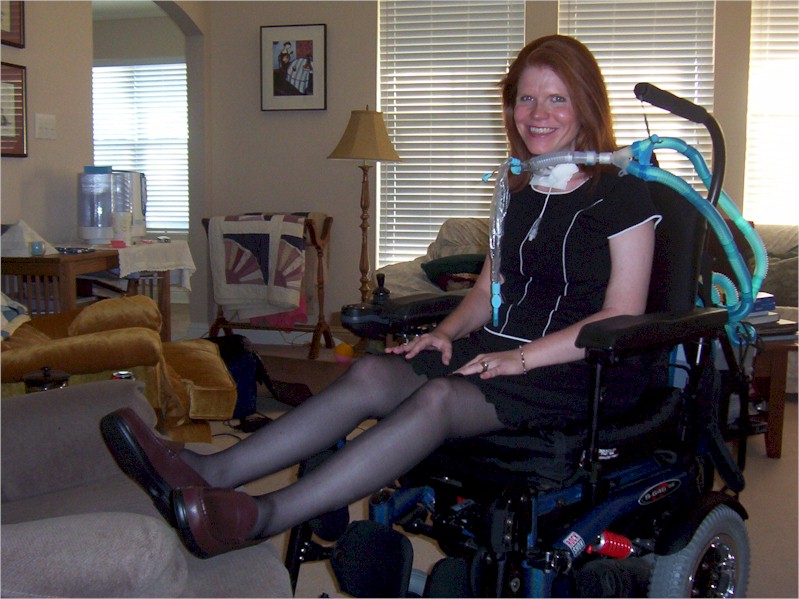
How do you move around?
At home I use a Quickie S646-SE wheelchair with a Roho cushion. The Pulmonetic LTV-950 mechanical ventilator is strapped onto the chair’s back. Tubes snake around the side of the chair from the vent to attach to my trach tube in the hole in my neck. Unless I am plugged into a charged battery specially enabled to work with the vent, I cannot be more than a few feet from an electrical outlet; meaning most of the time I’m on a short tether and cannot move far. Vents run on electricity, so if the electrical power goes out, that's a serious problem unless you have charged batteries and/or a generator you can use.
I cannot adjust my own body in the chair, either. I try to relieve pressure points by moving various part of the chair around: lifting my legs, leaning back, etc. However, unless manually lifted by another human being, I simply do not move out of one position. Being position-constrained starts to get uncomfortable after awhile (much more rapidly if I am in the manual wheelchair or sitting in a vehicle). Other people have to help me shift my weight to help prevent skin breakdown.
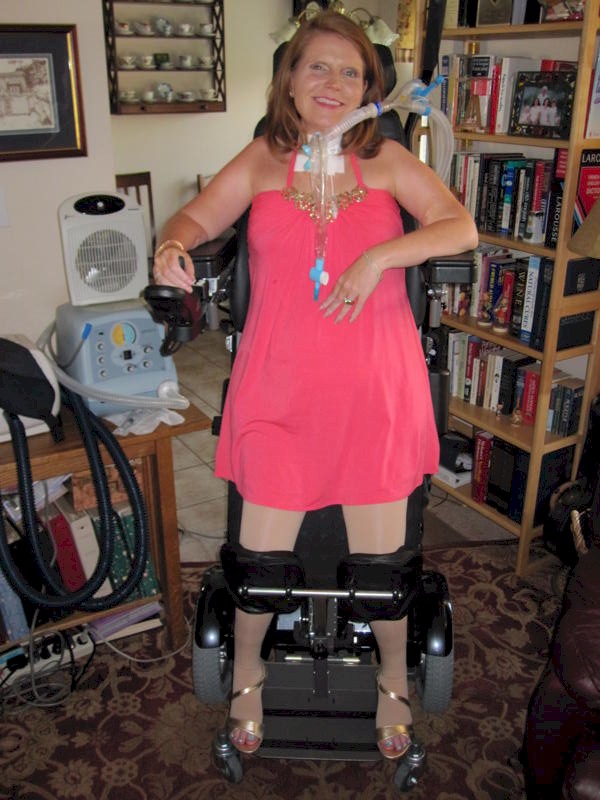
| Now I also own (in part due to generous donations) a Permobil standing wheelchair. This allows me to stand which helps stretch my legs, puts some pressure on them to reduce bone disease issues, allows me to urinate standing, reduces edema, and provides other quality-of-life benefits that both my husband and I appreciate. (The chest vest and cough assist device, respectively, are to my left.) |
 |
Of the two, I prefer the Quickie for comfort and ease of driving.
The Permobil due to its standing function remains a wonderful
and effective therapy. It stretches my tendons; allows my bones to
bear weight; seems to have reduced significantly the number of iron
substitute infusions I require for anemia. However, because it
stands and requires a longer cushion both behind my back and beneath
my derriere, I am uncomfortable sitting in it. The different
pressure from the cushions, given my disease state, and the way I am
transferred into it on the side can contribute to my pressure sore.
It also is more temperamental of the two, especially when it gets
slightly warm in the house or when it's in direct sunlight. At those
times it can stop functioning. On several occasions like those but
also more unpredictable ones, I have been trapped in a somewhat
upright and other awkward positions. Worse, the strap that holds the
knee plate (see above) has twice broken while I was standing, the
last time causing spraining of my ankle, knee, and arm. The
manufacturer assures that this is a rare occurrence, as I typically
weigh about 100 pounds and it's supposed to hold up to 5,000 pounds
of pressure, and are working to resolve this problem.
Unfortuately, as my knees became injured in unrelated falls, I am unable to use the standing function on this chair nay longer.
How do you travel outside of the house?
For the first six years from the introduction of mechanical ventilation into my life, I mostly stayed at home. To travel in a vehicle anywhere, even a mile from home, we had to bring my vent, ambu bag, suction canister (with saline cartridges), an external battery, and the manual Quickie Iris wheelchair, cushion, and footrests (the power wheelchair weighs 250 pounds and is very difficult to transport without a large adapted van with a lift and proper tie downs, all of which we lack). It's fairly unsafe to travel more than a few miles without the support of two or more people trained to help me breathe with an ambu bag (should the vent or vent battery fail) and trained to operate the vent (should tubes disconnect, knowing how to reconnect), etc.
But in 2008 we got a well-equipped, adapted van modified by RollX (check out their site in my Health care, Equipment section). The van will kneel and produce a ramp, and inside it has a locking system that enables me to drive in and lock myself in place on the front passenger's side. With a seat belt, I'm securely in without having to be transferred. This works only with the Quickie wheelchair because only one model at a time can be modified in tandem with the van to fit into the locking device.
We've only attempted one overnight, non-business trip since my vent dependency; that was in 2004 in the old van. Thankfully, we had extra human support along joining us. Beyond that, all sorts of other things had to be packed -- medicines, a backup battery and vent, a generator, oxygen, suction canisters, lots of supplies for treatments as well as extra parts for the vent. Initially my insurance company allowed me to have a backup vent; now I lack that. This also makes it dangerous to be far from my local durable medical equipment provider, which does house a backup vent they can bring out when mine fails, as it does every year, more than once, but always unpredictably. In the best of circumstances it has taken over 3 hours for the respiratory therapist to come with the vent; all the while I am being sustained by an oxygen tank hooked up to an ambu bag manually compressed by a skilled individual; someone lacking in skills could rupture my lung. Further, I do not travel comfortably anymore; muscle loss means pressure sores easily arise, particularly since I cannot shift my own weight. Someone else must be able to do this for me. Typically a driver cannot. Moreover, the vent has to be arranged so I can use on it during the drive; this can be accomplished with a power inverter plugged into the cigarette lighter.
The new van alleviates all of these for a longer ground trip of which we have yet to try, past the 250 mile one-way trips to Baton Rouge when I served on the Louisiana Developmental Disabilities Council. We haven't yet attempted air travel given the policies airlines have regarding traveling while using a vent and regarding transporting equipment. We used to consider airline travel before the tracheotomy complicated matters, but now it's practically out of the question. There is a service we’ve not tried, however, that looks viable: chartering an air ambulance.
To what degree are you limited in your daily life besides the obvious dependence on a mechanical device to breathe?
Muscular dystrophy and vent dependence limit my life in many ways. I am fortunate compared to many in my condition that I spend the majority of the day out of bed, I can communicate relatively easily (many in my state cannot talk), and that I don't need a urinary catheter or colostomy bag.
However, there are several dilemmas of which we must be aware that perhaps never are issues with somebody who is relatively healthy (in addition to other challenges mentioned in other parts of this website; for example, potential pressure sores from the continuous pressure on certain parts of the body by sitting in the wheelchair or shower stall, lying in bed, etc -- no position, due to the tracheotomy and immobility, allowing me to remove pressure from the buttocks):
- Diet must be controlled to prevent unfortunate side-effects. For example, too much sodium intake means more retained water, which proves especially problematic given reduced cardiologic capacity (onset by both the disease process, sedentary lifestyle, and the positive pressure the vent creates in what typically is a negative pressure system -- that is, the vent pressure forces fluids back into the heart as it pushes air into the lungs). Even with a careful diet my waistline and abdomen, for example, can expand as many as four inches a day, leading to discomfort; during the day I swell all over; hours reclining in bed helps the fluids shift to proper locations; however, too much bed rest also causes severe edema.
- Besides the kinds of foods that are better or worse for me to eat, there is the matter of their texture as well. For example, foods that crumble like dry bread often get caught in my airway (aspiration), which can increase the risk of pneumonia; so I must avoid these.
- In order to avoid bowel impactions brought on by a lack of mobility, diuretics, and medications, drinking plenty of liquids that do not dehydrate proves necessary. However, that means more trips to the bathroom requiring either using cumbersome, inefficient lifting equipment and a portable toilet or, much quicker but more taxing to the lifter, someone transferring me from wheelchair to commode and back again. My toileting needs thus burden others, which I regret; but (with their blessing) others endure the strain to avoid the much greater medical problems that can come from catheters. I do limit my fluid intake, and I always do my best to time when I will need the restroom. Thankfully I have a great capacity to hold my urine for prolonged periods, excepting when using diuretics or pre-menstrual; and then my capacity is above typical. However, I rarely can drink all that I want when I want. And on rare occasion I go 12 or more hours without anything to drink.
- Restroom difficulties become multiplied by the fact that I do not live in hospital gowns but wear regular clothes. This means getting clothes out of the way when I sit on a toilet which itself which also can lead to choices that have their strong and weak points: for example, the easiest underwear for me to have removed is a thong or g-string, yet girdle-like underwear to control my edema helps me the most physically; but getting those up and down is a two-person job: one person holds me up while another pulls. So those are not often feasible. Rest room issues restrict my fashion choices: for example, it is really impractical for me to wear pants anymore, and wrap or fairly short skirts are the least restrictive. It's also mandatory now that I wear some kind of support hose, the higher the better. But, again, those coming up to the waistline would be too difficult for one person to manage in taking me to the restroom. I used to wear compression knee highs (even with short skirts, yes) but now I must wear exclusively compression thigh highs of the highest tension; within an hour of not doing so, my legs are in great pain. Recently I've gotten similar items for my arms and hands.
- Air quality has become tremendously important for me. The equivalent of just a couple of puffs of cigarette smoke emerging into my breathing space is enough to cause me breathing problems, so I am glad that governments are banning indoor smoking. Humidity and poor ventilation also cause me problems: I seem to have more trouble breathing when storm clouds form and rain comes down or in places with semi-stagnant air, including some elevators.
More about Deshae
Frequently asked questions: mobility issues
Frequently asked questions: pulmonary issues
Frequently asked questions: personal care issues
Frequently asked questions: her spirituality
Frequently asked questions: her tastes
Ulina (off-site)
Photo gallery (off-site)
Earliest years photos (off-site)
Port access photos (off-site)